


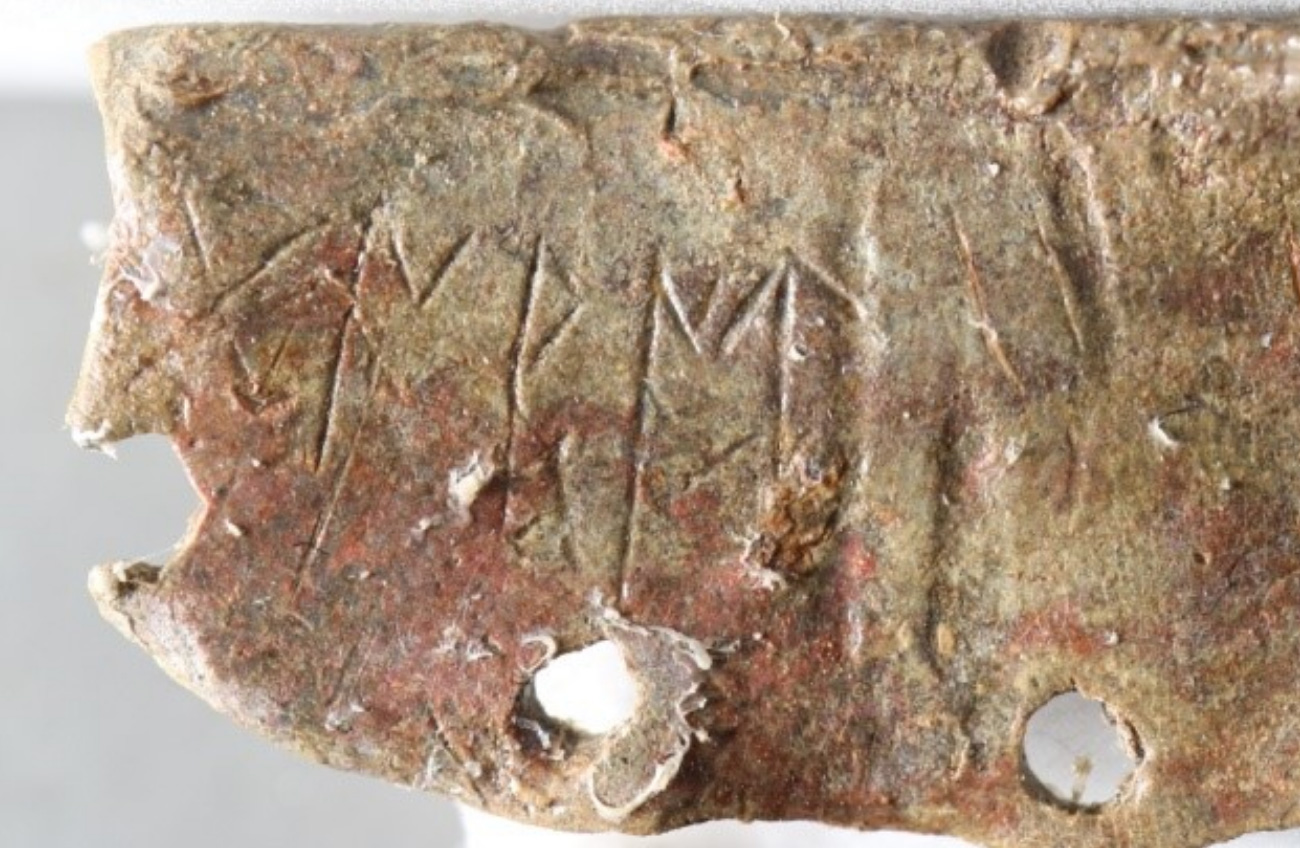
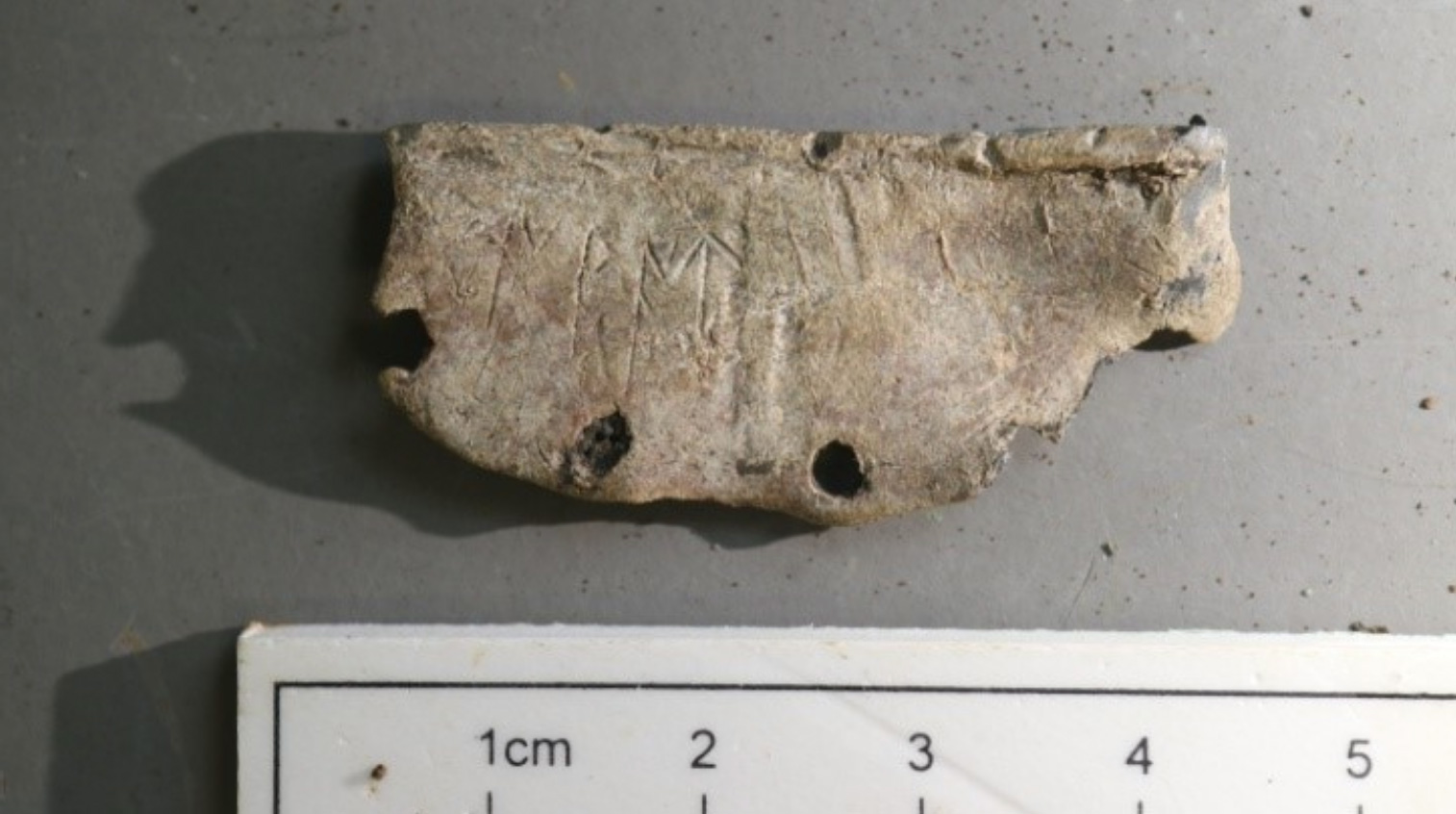
In 2023, we found a very small lead sheet with five Anglo-Saxon runes scratched into it. Runes such as these were in use in the 8th to 10th centuries.
We have now received an interim report from Prof. John Hines, the country’s leading expert on runes. His comprehensive report can be found at the link below.
In summary, Prof. Hines believes that the runes read gabot, translated as “Go, remedy”. As such, it is probable that the sheet and runes formed a healing charm.
This would be entirely in keeping with our growing picture of the abbey as a place of healing. The sheet has nail holes so it was clearly attached to something at one time.
Indepth Analysis:
An inscribed lead plaque from Cookham Abbey, Berkshire
Background
The chequered 8th-century history of a monastery at Cookham in Berkshire is well known, largely thanks to the summary given in a charter issued following the Synod of Clofeshoe, AD 798 (S1258; EHD I no. 79), which in turn reflects the strategic importance of the location, on the Thames and just south of the Chilterns, territory over which the kings of Mercia were keen to assert control in the period of the ‘Mercian hegemony’. The site has been identified adjacent to the now parish church of Cookham, Holy Trinity, and has seen five seasons of excavation directed by Prof Gabor Thomas of the University of Reading. In 2023 a lead plaque inscribed with runes was found in a substantial midden deposit, layer 3021, that is firmly datable to the 8th century by coins and pottery finds (pers. comm., G. Thomas). The inscribed plaque has small find number Δ1219.
The object
The inscribed object is a piece of sheet lead 0.45mm thick. The edges of the lead plaque are smooth and rounded in profile in some areas while ragged and clearly torn in others. From this we can identify original edges of the plaque with confidence, and this is significant in establishing that the runic text is complete.
The sheet itself has been folded in two. The fold is in the direction of its maximum length, which is 40.5mm. One of the folded sides has a height of 18.6mm and the other one of 15.2mm. With a rounded ridge 2.6mm across at the fold this indicates that what we may call the original or unfolded width of the inscribed sheet was around 36.5mm. The higher side is that which carries the inscribed runes, and this will be referred to as the ‘face’, with the other side being the ‘back’. The lower outside edges of both the face and the back were clearly curved in outline, but the unfolded lead sheet does not appear to have formed anything that could be described as a disc. Original shorter edges at each end in fact are gently but definitely concave. A slight taper from one side to the other means that one might consider the original sheet to have been ‘leaf-shaped’, but such a description must be used with caution because there is no suggestion that it was made to resemble a leaf.
There are nail holes along the outer edges of both the face and the back, five on each side. These align quite precisely between the face and back, indicating that the same nail passed through both sides in each case. From microscopic examination of the shape of the nail holes it can be established that the nails were driven from the face through the back. The lead sheet seems likely, therefore, to have been folded in two and then nailed on to some object, presumably of wood. It is possible that something was sandwiched between the face and the back, but if so that could have been at most 1.5mm thick. This is too fine for a prepared piece of wood, but, in light of a plausible interpretation of the text (below), the possibility of a piece of parchment, or sheet of bark or the like, is an interesting one. There are no marks on the outer face of the back to suggest that these were rivet holes, or that the shanks of the nails were hammered over to clench the folded plate shut.
The folded sheet also has a curved outline lengthways. With the rounded ridge where it was folded this makes it resemble a rim-patch; if so, the curvature would imply a vessel of c. 350mm in diameter. However, it also appears quite likely that this shape is due to bending when the plaque was prised from whatever object it had been nailed to. There are fairly clear toolmarks from some sort of tongs where it was gripped, and these would indeed be consistent with the curvature being the result of this process of dismantling and decommissioning the mounted plaque prior to it being discarded in the midden. But note further the discussion of the inscription, which follows.
The inscription
The inscription consists of five runes, definitely characteristic of the Anglo-Saxon fuþorc. They read from left to right, and the first rune stands alongside a well-preserved original edge, so we can be confident that nothing has been lost that preceded this short string. The runes are also positioned quite carefully above the nail holes, suggesting that the inscription was made after the plaque had been nailed into position.
But otherwise the runes have not been cut all that neatly. A consequence of this is that there is some room for doubt about the identification of the fourth rune in the sequence. The others read g a b – t. The lower pocket of the b rune is slightly obscured, but parts of the two lines forming it are sufficiently clear. The fourth rune can be indentified as o, although a line which would form this rune (ōs in the fuþorc) rather than a (āc, as the second rune), is not clearly attached to the rest of the graph, nor quite as firmly cut as the other runic staves. My own judgement is that these are aspects of the relatively casual or careless way in which the runes had been cut, and that o is by far the most likely reading. That position is based both on interpretation of the marks on the face of the folded lead plaque, and what they produce in terms of intelligible text.
gabot offers a straightforward and plausible reading in Old English, as two words: gā bōt. gā would be the imperative singular of the verb gān, ‘go’, and bōt a feminine noun meaning ‘cure’, ‘remedy’. The short text could then be translated ‘Go, remedy!’, and interpreted as an imperative addressed to a cure, possibly a charm, to put it into action. That of course makes the possibility — admittedly an imaginative, but not an unrealistic one — that some other sheet which may have carried the text of a charm, or some healing material, was clenched by the folded sheet and also nailed in place. While I know of no exact parallel to this kind of instruction being directed at the charm itself, the imperative tone is certainly characteristic of the vernacular charms we have preserved.
It should be noted that if we read gebat, the text would be equally grammatical and straightforward, meaning ‘Go, boat!’. One would have to employ a great deal more imagination to construct a scenario in which this were an appropriate text.
Another very similar Old English word which it is appropriate to note and consider is gabote, a noun recorded only in a related group of glosses (which means, in effect, we have a single attestation of the existence of the word), giving a translation of the Latinized Greek noun parabsidis, ‘serving dish’. In one case the noun is cited in the singular, in the others in the plural, as gabutan and gavutan. These represent the Latin noun gabata, ‘dessert dish’, adopted into Old English as a loanword. Typically for a Latin 1st-declension noun it appears as a weak feminine (n-stem) noun, ending in -e in the nominative singular and -an in the nominative plural. The change of a to o or u in the middle syllable is curious: this is not a regular sound-change in Old English or any earlier stage of Germanic the loanword might have passed through, nor explicable as a Vulgar Latin variant. gabata, often spelled gavata, and frequently in the plural ending in -ae, appears moderately regularly in Early Medieval Latin sources from the Continent, specifically in ecclesiastical contexts: the medial vowel never varies. The rim-like appearance of the folded sheet could be congruent with this lexeme: clearly gabote was specialized vocabulary, but it would have been known and used in an 8th-century monastic context if anywhere. Here, though, the absence of any inflexional ending required for the weak feminine noun is significant; we could only read gabot as another form of the word for ‘dish’ by postulating a variant of the noun in one of the ‘strong’ declensions: most likely a feminine ō-stem. That is not beyond the bounds of possibility, but, with no contextual reason to make that identification, the more we have to construct special circumstances such as this, the further from probability we put ourselves.